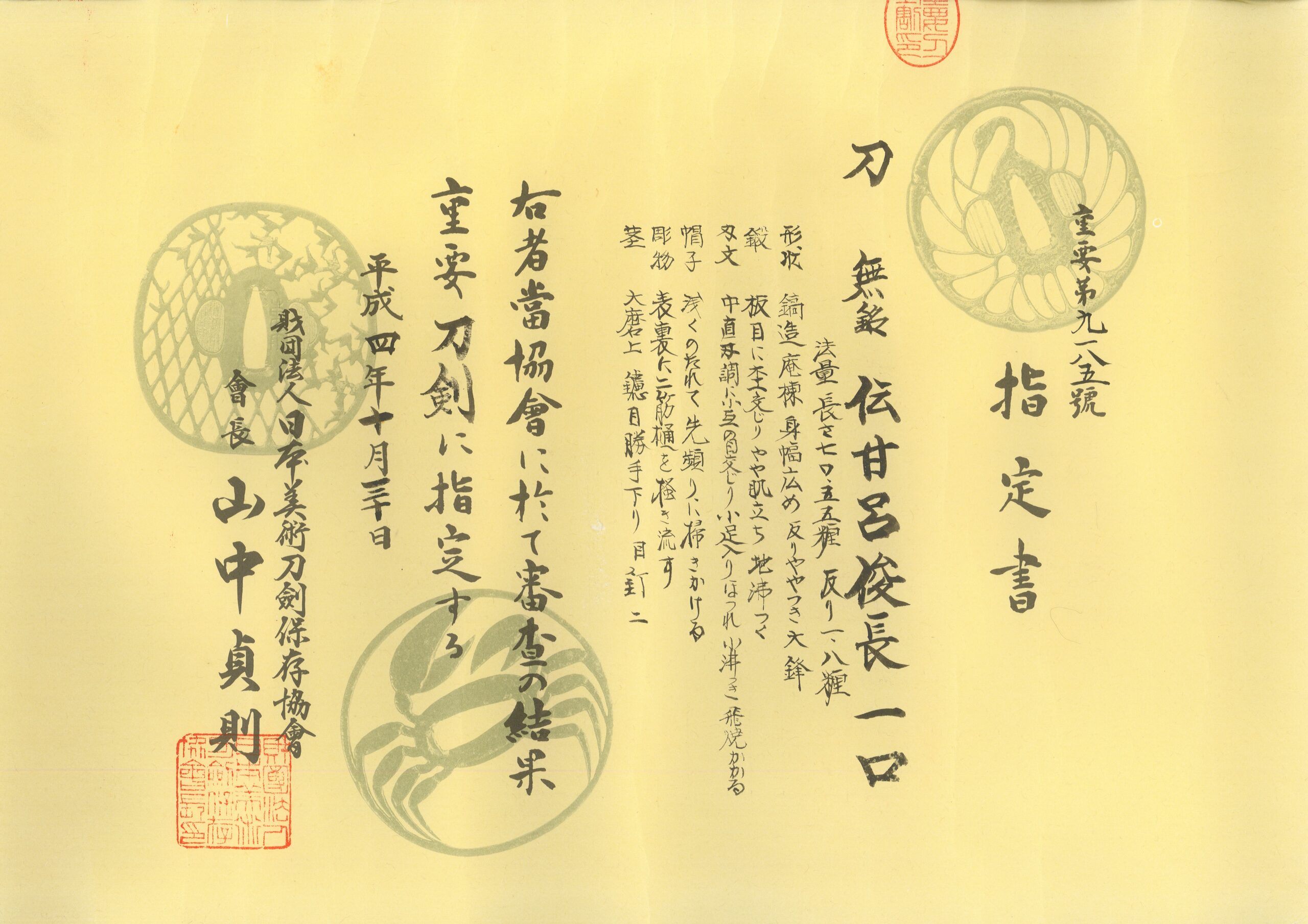
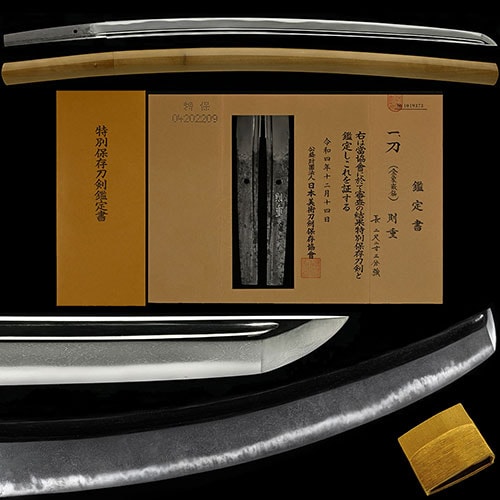
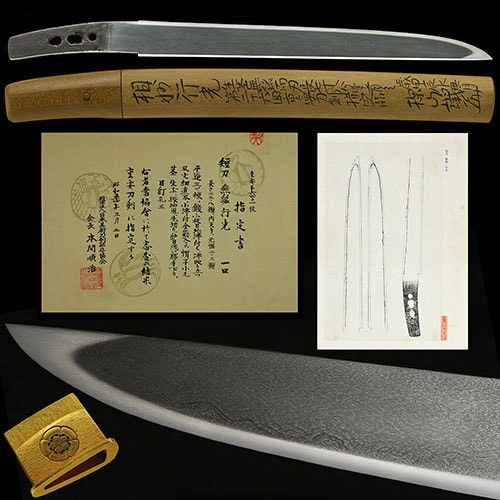
Heianjō Nagayoshi is said to descend from the lineage of Heianjō Mitsunaga of the late period, and several generations of smiths worked under this name. While sword reference works record the name from the period onward, no extant works can be attributed to that early date; the surviving body of work belongs to the period, with dated examples spanning the Bunmei through Tenbun eras. Together with Yoshinori, Nagayoshi stands as a representative swordsmith of late Yamashiro. The has observed that in the construction of the tang and in the workmanship of both and , Nagayoshi shares notable points in common with Muramasa of , indicating that the relationship between the two "was not a shallow one."
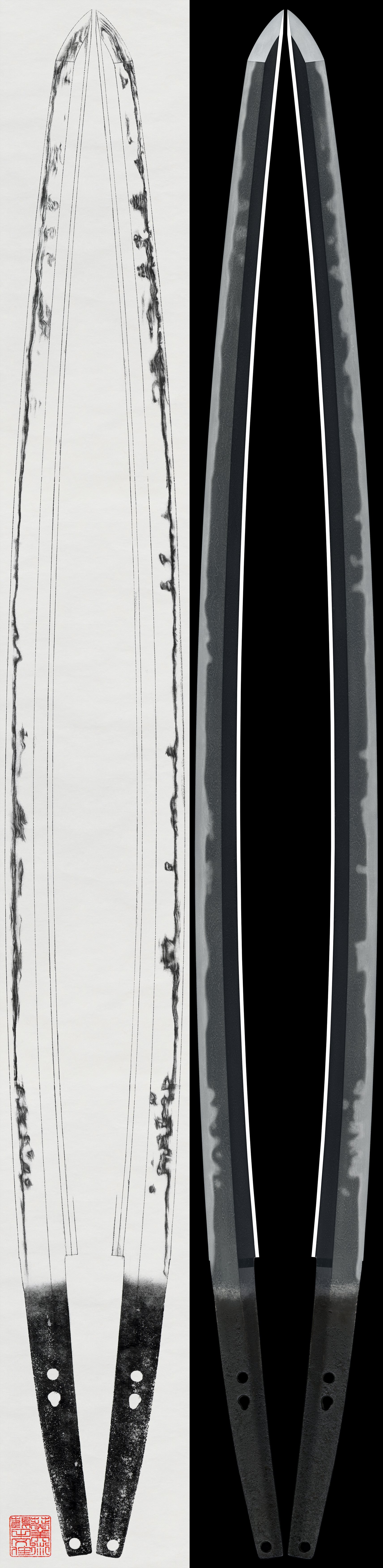
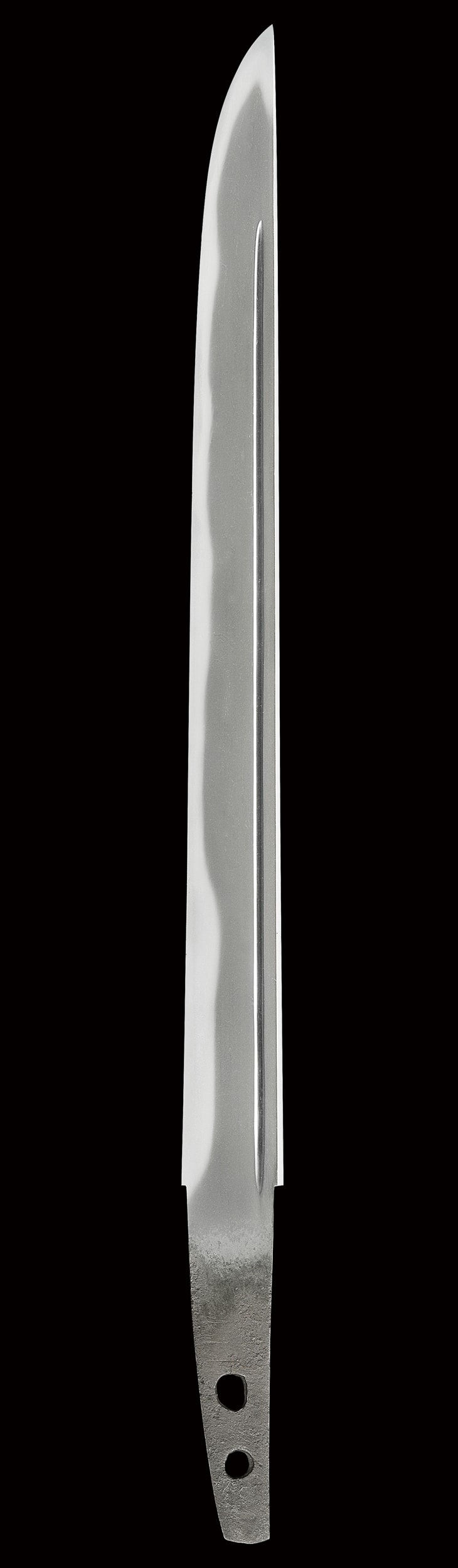
Nagayoshi's characteristic is a mixed with , often showing angular or squared turns, and a distinctive feature of his work is that the temper on front and back corresponds closely. The is typically , at times mixed with , with adhering; some pieces show a flowing tendency with slightly standing grain. The inclines toward a tightened quality, with and appearing. While most works exhibit this restrained mode, Nagayoshi was also capable of a more demonstrative -like temper of - flavor, though even in such pieces the remains tight -- distinguishing his work from the older tradition. His frequently adopt a compact, stout (zunguri) form with , and he produced blades in uncommon constructions including katakiriha-zukuri. The that appear on his works -- particularly carvings in both and styles -- are recognized as among his specialties and are executed with considerable skill.
Nagayoshi's oeuvre encompasses , , , and , revealing a breadth of production characteristic of an accomplished late workshop. His works are valued both for their consistent technical quality in and and for their documentary significance; dated examples, such as those bearing Meiō-era inscriptions, constitute important reference material for the study of Yamashiro swordsmithing in this period.