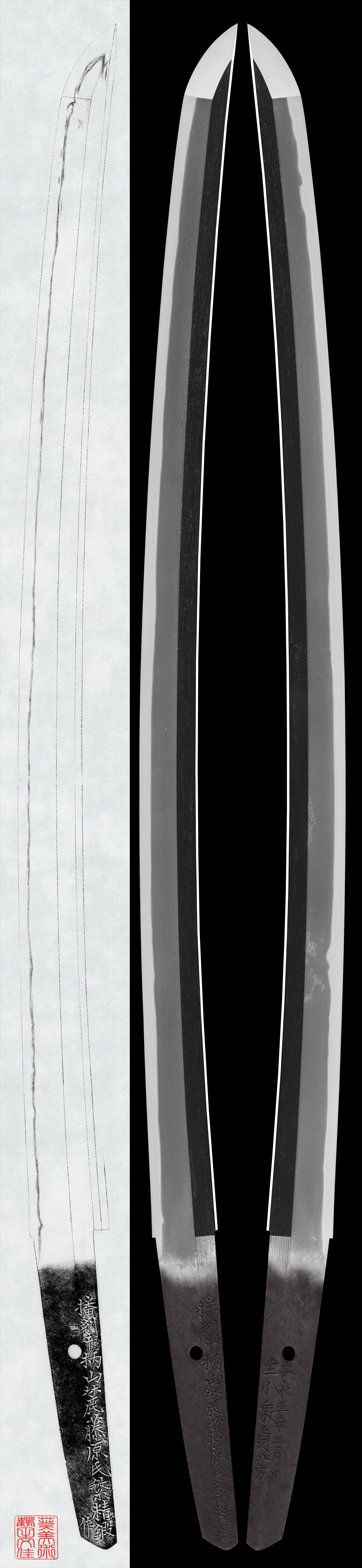
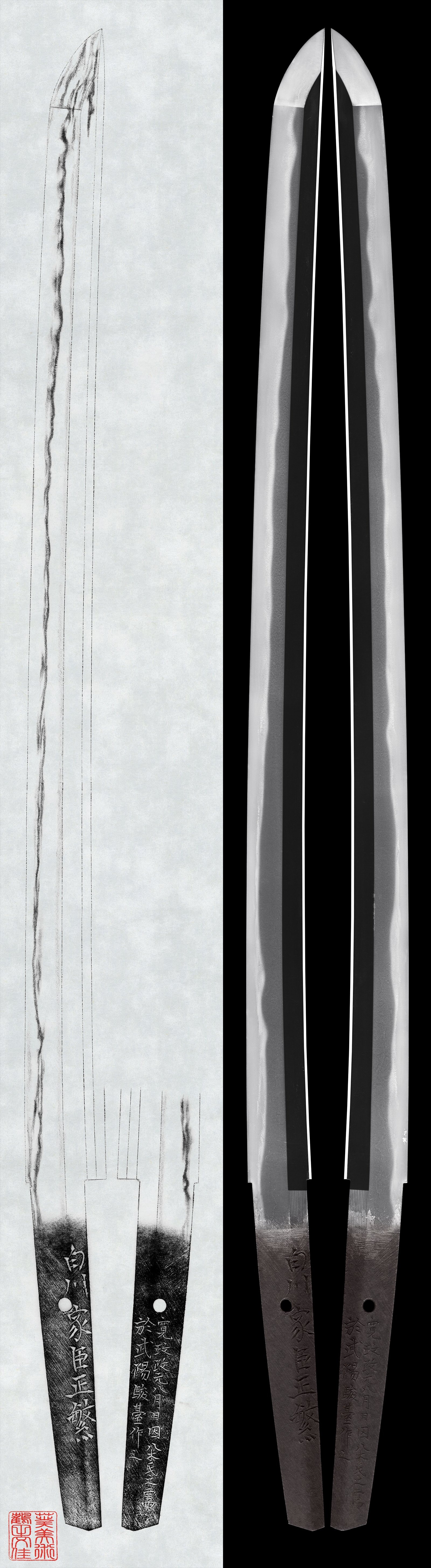
Tegarayama Masashige was a Harima swordsmith of the late eighteenth century who carried the billowing toran- of Osaka into the revival, his dated work running from the Kansei years across blades signed at Surugadai in . He belonged to the Tegarayama line of Himeji, a house descended from the first-generation Yamato no Daijo Fujiwara Ujishige that took its name from living at the foot of Mount Tegara. The published sources record that he was the younger brother of the third-generation Ujishige, that he first signed Ujishige and succeeded as the fourth of that name, and that he later changed his name to Masashige; his common name was Asashichi and his art name Tankasai. In the winter of Tenmei 8 (1788) he entered the service of Matsudaira Sadanobu, the lord Rakuo of Shirakawa in Oshu, as a retained smith, and moved to , where he worked at Surugadai in Kanda. This patronage explains the tang inscription Oshu Shirakawa- that recurs across his blades, naming his lord's northern domain rather than his Harima birthplace. In Kyowa 3 (1803) he received the court title no Kami, and from his lord the two characters Shinmyo, which he is said to have reserved for the works he counted his best.
His hand is the toran- he learned by private admiration of Tsuda no Kami Sukehiro, and the published record names it without qualification as his chief specialty. Over a wide with shallow and an extended , he opens the temper at the base with a straight , then raises a large that crests into the surging wave of toran. The published sources describe the result as a manner in which he 「津田助広の作風に私淑して」 (privately admired the style of Tsuda Sukehiro) and 「濤瀾乱を最も得意としており」 (was most accomplished in toran-). What distinguishes his toran from a plain copy of the Osaka model is a controlled order to the pattern; of his finest work the writes that the irregularity, with large as its principal theme, 「大互の目を主調とした乱れの形はくずれることなく整然と」 (remains orderly and does not collapse), the adhering evenly and thickly while and alike work brightly.
Into that large- edge run pointed elements, and the published sources treat them not as accident but as a recognized mark of the smith, noting of one that 「尖りごころの刃が交じっているが、これは同工の特色である」 (pointed elements are mixed in, and these are a characteristic of this smith). In places arrow-nock -like teeth enter the temper as well; on one where 「矢筈風の刃が交り」 (-like teeth are mingled in) the published sources read the touch as 「言之進照包を意識したもの」 (a glance toward Gonnoshin Terukane), widening his toran beyond the single Sukehiro source. The runs straight into a , at times with and a long , and , and gather at the edge of his most active blades, which the likens to 「打ち寄せる波濤」 (waves breaking on the shore).
The is a densely forged thick with , in places settling into a quiet, nearly surface, and at its finest carrying fine with a clear steel. Beside the toran the published sources name a second, calmer manner of his own, a shallow with a wide , the deep and adhering well; it is the hand of his and of several , and on a dated Kansei 7 (1795) the record notes that the long and short blades match well in a shallow . The published sources also report that in he 「水心子正秀に学んだ」 (studied under Suishinshi Masahide), the leader of the revival, so that his work joins the Osaka inheritance of Sukehiro to the new schooling of his own day. He carved his own , dragons, and the vajra-hilted among them, and a of the seventieth session records on its tang that the carving is by the hand, which the treats as raising its documentary value. Around the start of the Bunsei era he forged for a time in Osaka before returning to .
His distinction is best read against the Osaka source he admired. Where Sukehiro's toran is the originating model, Masashige's is recognizable by the that opens it, the pointed and arrow-nock mingled into its crests, and the order he keeps in the large so that the pattern does not break. He stands within the Tegarayama house of Himeji, the younger brother of its third-generation Ujishige and the smith who carried that line's name into the service of Shirakawa; among the Tegarayama smiths the published sources hold him the most accomplished hand of the toran manner. His blades are further set apart by their inscriptions, which record not only the date but the place of forging at Surugadai in Buyo and, on occasion, the iron itself; one forged from Sekishu Dewa material is compared by the to the practice of Katayama Munetsugu and valued as documentary evidence.
Masashige is rated Jo-jo by Fujishiro, a highly skilled smith of the period, and thirteen of his blades are held in the tier, which is the whole of his designation record; the swords are of the kind a private collector may realistically encounter, surviving in long-held and largely unrecorded hands. His provenance is sparse but specific: one was made to the order of Kosugi Tamenaga, a retainer of the domain, and bears on its reverse an old proverb on the uses of long and short, beneath the owner's own inscription. A blade of his comes to market only from time to time, and a signed, dated example with his self-cut carvings, or one bearing the granted Shinmyo characters he kept for his best work, is the more notable when it appears. For a collector seeking the toran of the revival rendered by a 's own smith, Masashige is among the surest names, his deep and bright, clear the steady mark of a hand the published sources call thoroughly skilled.