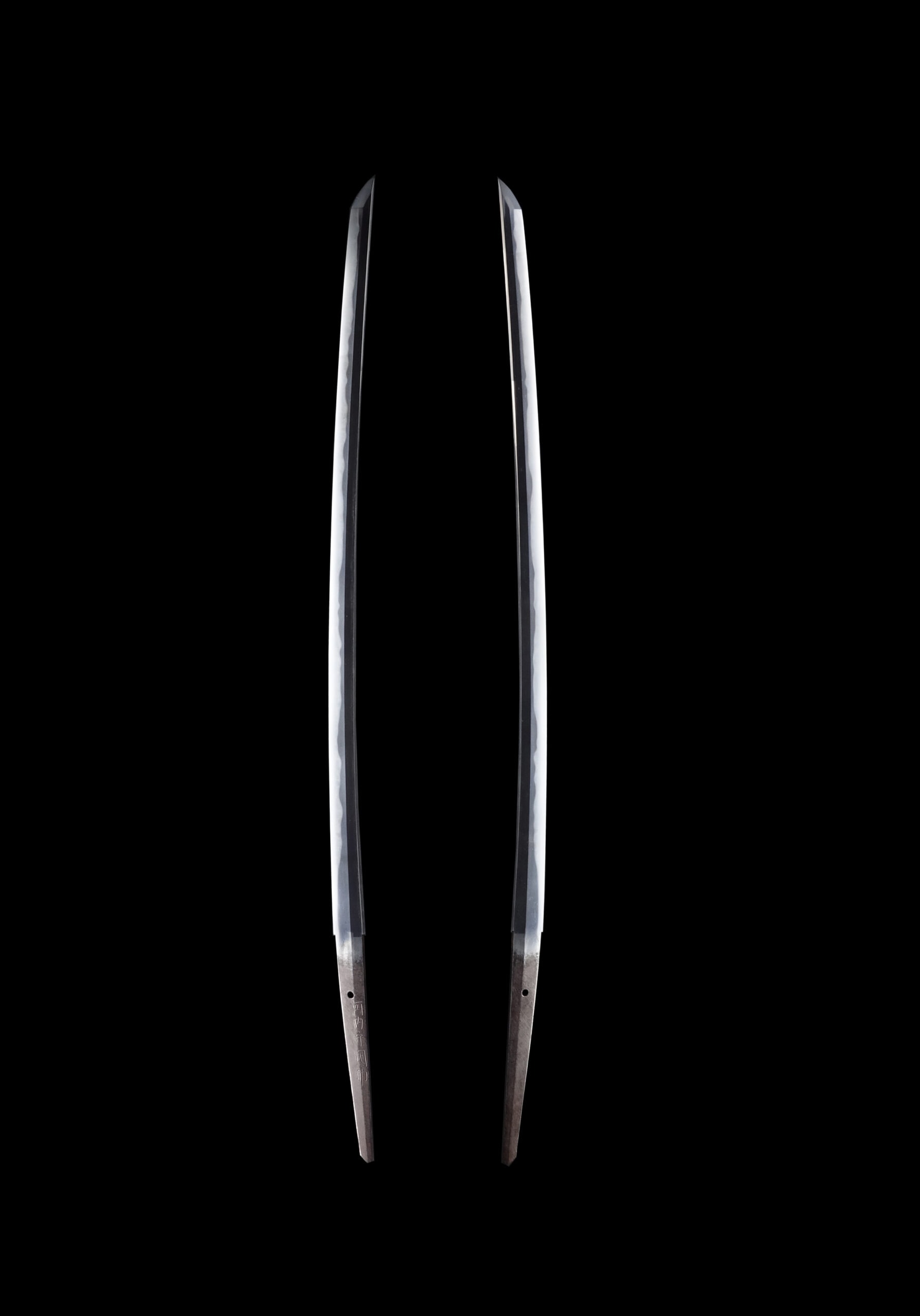
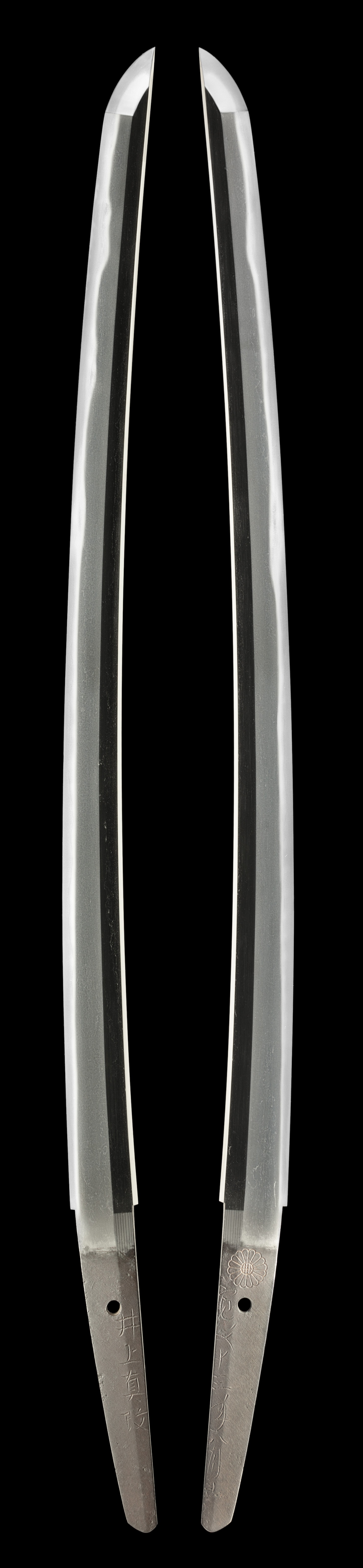
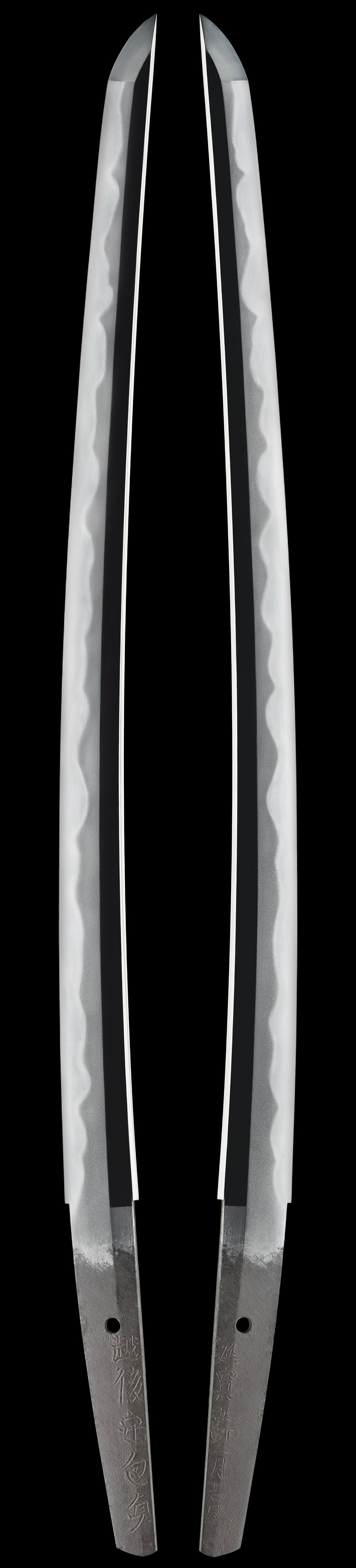
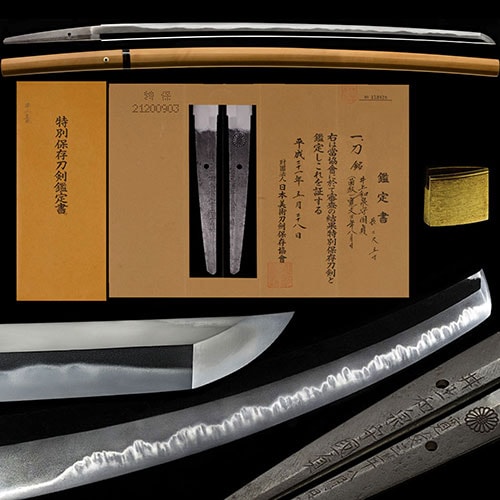
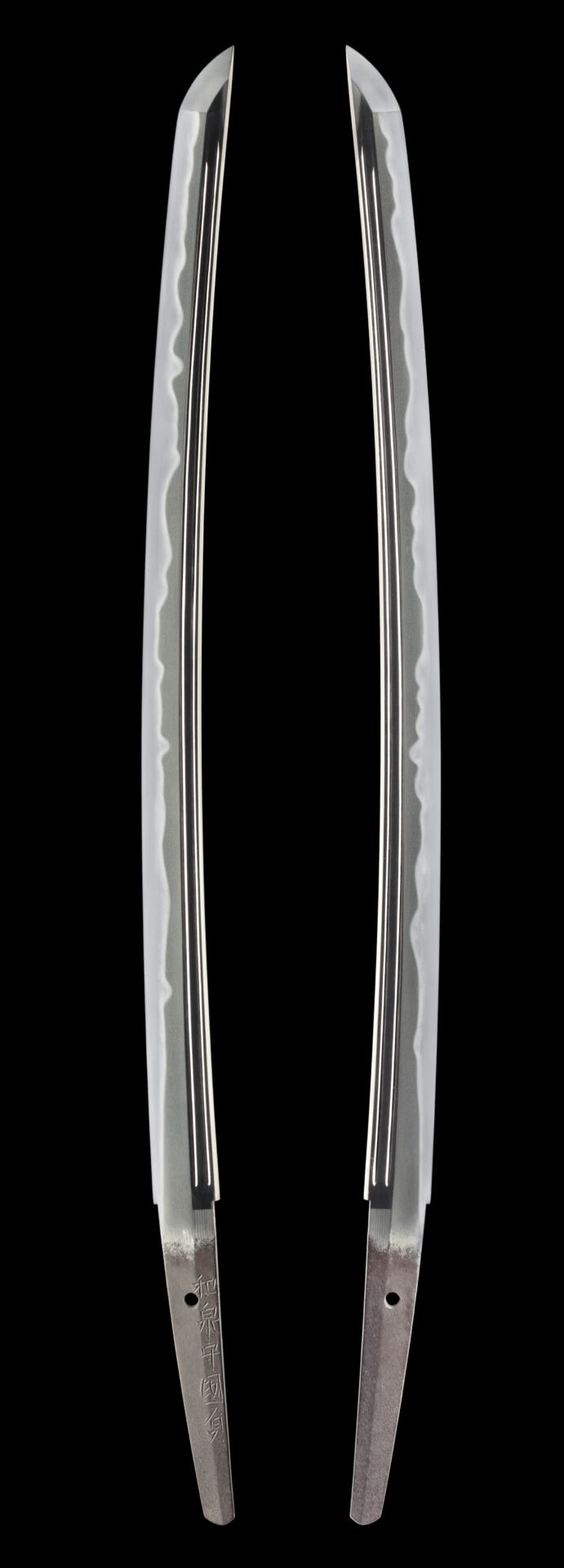
Kobayashi no Kami Kuniteru, also known by the personal name Hayanojin, was the fourth son of the first-generation Kawachi no Kami Kunisuke and the younger brother of the second-generation Kunisuke (Nakakawachi). In 11 (1671) he received the court title Daijo, and in the spring of the following year changed it to "Kami." As recorded in Bengi, he is believed to have lived until around the Shotoku era (1711--1716). Distinct in character from his elder brother Kunisuke, Kuniteru excelled in the billowing toran-style grand - patterned after Tsuda Sukehiro of the second generation. After the successive deaths of the two senior masters of Osaka swordmaking -- no Kami Sukehiro and Inoue Shinkai -- Kuniteru assumed an important position as one of the foremost figures in the Osaka forging community. From Genroku 10 through 12 (1697--1699) he traveled to Awa Province, and extant works bear supplemental inscriptions noting his place of forging at Tsubaki-domari and Tokushima.
Kuniteru'sforge work characteristically displays a tightly forged with adhering thickly in minute particles and fine entering abundantly, producing steel that is notably clear. His , when rendered in his signature toran idiom, takes the form of a large-patterned with deep , well-adhering , and conspicuous ; the is bright and clear. Yet his range extends well beyond this domain: certain works present a fundamentally -based temper bearing a shallow tendency, with long entering strongly in the manner termed Kyo-, while fine and run throughout. In these pieces one observes aspects that vividly recall the work of Inoue Shinkai -- notably in the depth of , thick adherence of , and the bright, clear -- together with a very fine activity along the boundary between and likened to paper torn from a sheet of hosho-gami, a quality comparable to the second-generation Sukehiro. The typically becomes somewhat straight and linear, turning back in with a long . From the Genroku era onward, his tang construction took on its characteristically distinctive gohei-gata form, which is immediately recognizable among Osaka smiths.
Kuniteru's finest blades demonstrate that his technical capacity is not confined to toran- alone but is equally commanding in other stylistic domains. When working in a -centered mode, his temperament grows bold and rich in rustic character, with irregular and , , and scenery suggestive of producing spirited pieces of good workmanship throughout. His of grand proportions -- wide build, deep , and extended -- convey a palpable sense of power, with abundant and excellence of and creating what the terms a grand and heroic presence. Kuniteru thus stands as a smith of considerable versatility within the first rank of the Osaka tradition.