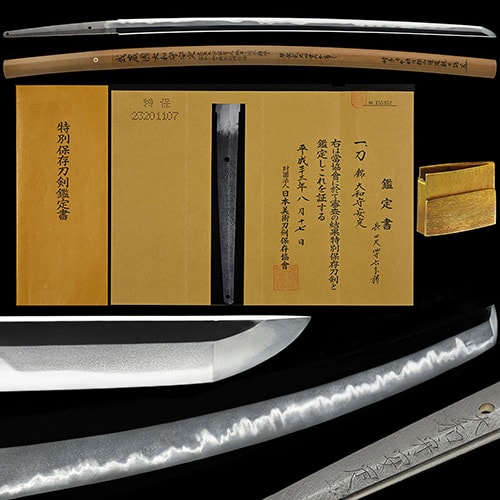
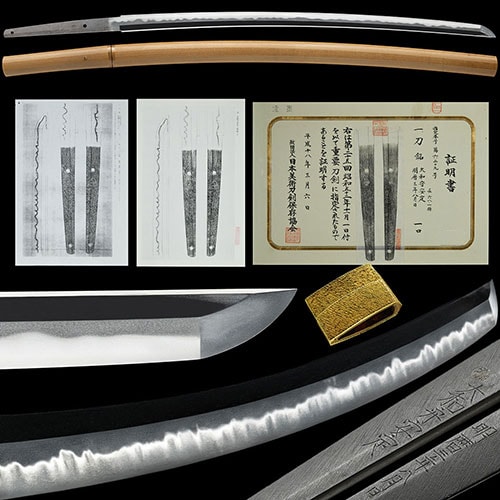
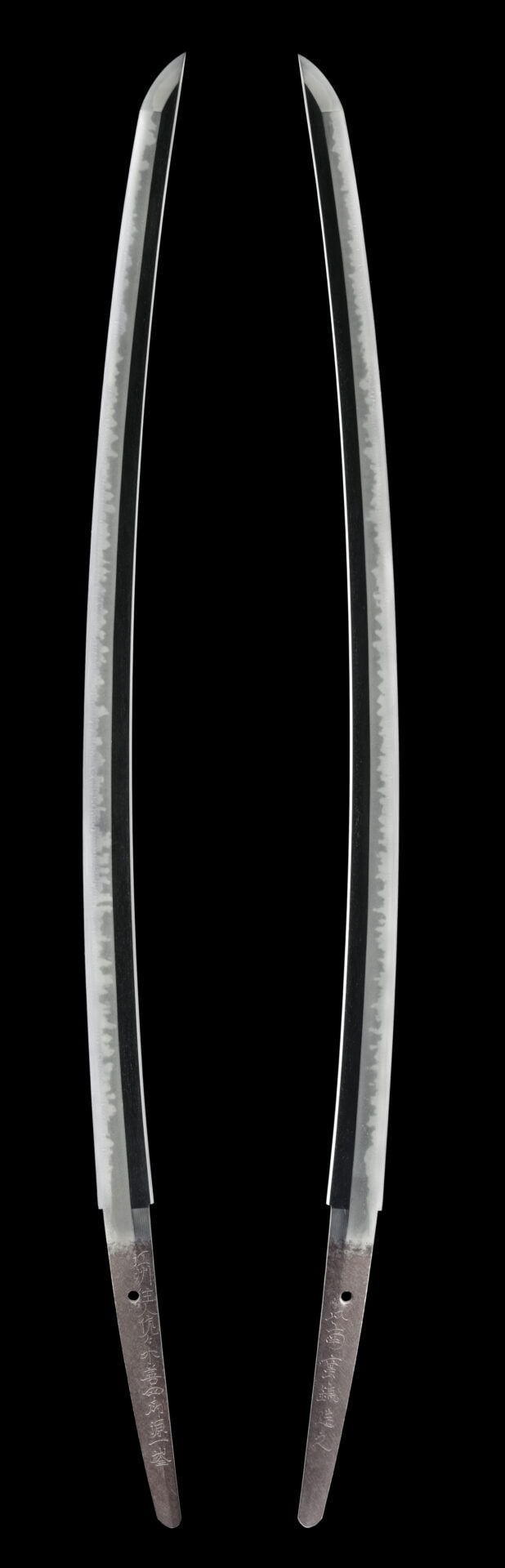
Korekazu, by common name Masatarō, was the seventh-generation head of the Ishidō line, the house that carried the tradition into the capital and kept it alive through the revival of the nineteenth century. The published sources fix his biography in a nearly fixed formula repeated across his designation entries: he was a nephew of the Yonezawa domain smith Katō Chōunsai Tsunatoshi, learned forging first under Tsunatoshi, then married into and succeeded the sixth Ishidō Korekazu, and died in Meiji 24 (1891) at the age of seventy-five. His working life ran from the closing years of Tenpō into early Meiji, and comparatively many of his blades survive, nearly all of them signed and dated . He stands among the leading masters of the late period; the published commentary ranks his skill alongside Jirōtarō Naokatsu and Hosokawa Masayoshi.
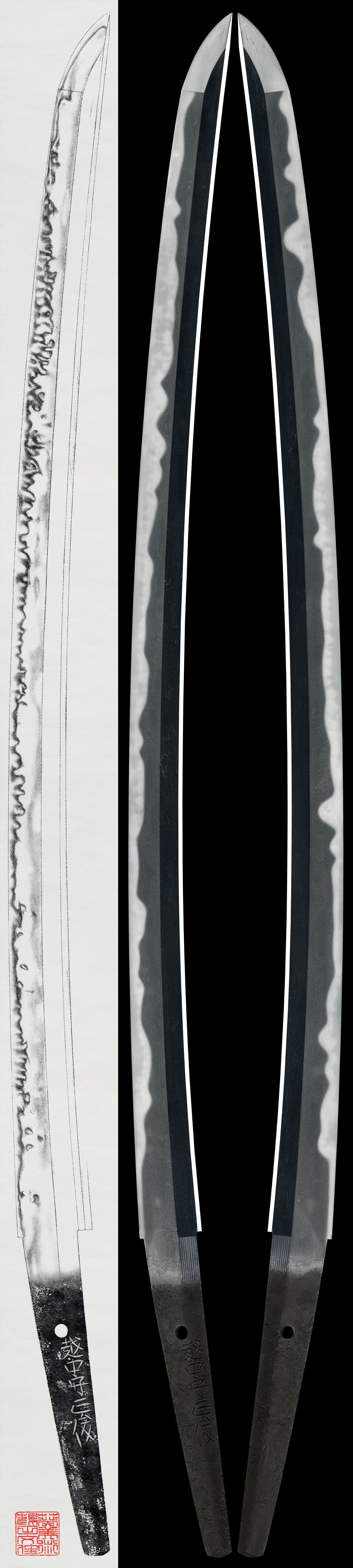
His hand is defined not by a motif but by a method, and the published sources state it the way again and again. His works divide broadly into two modes, - and Sōshū-den, but his true strength lay in the that may be called the hereditary specialty of the Ishidō house. Where the other smiths working in the manner tempered their in , Korekazu tempered his in , and the commentary locates his originality precisely there, summing it up as the work of a smith popularly described as having "tempered -style in ", so that "in this one can discern his originality". Over a well-packed he sets a mixed with , , and slightly pointed elements, the entering long and frequently, the deep, the thick with patches of coarser that leave the temper a little uneven, and through it run and long . It is a pattern carried on a base, and the threading nearly four of every five of his blades is the visible proof of it.
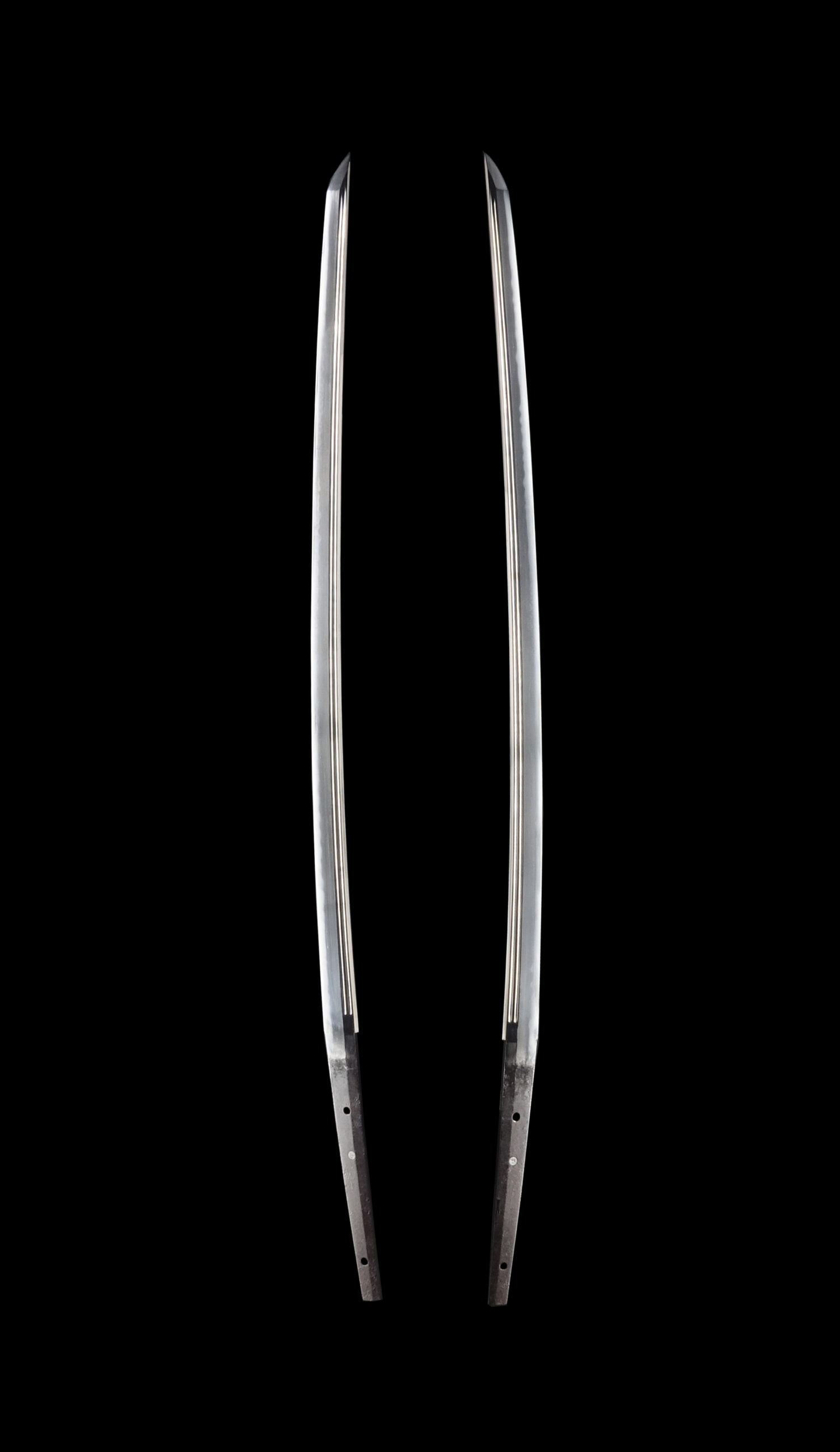
The is the constant that underwrites the temper. His is tightly forged, at times mixing flowing grain or , the laid in a dust-fine, thick cover with fine entering frequently, and where the forging tightens hardest it approaches a -, near-featureless surface. The published sources single this forging out as especially strong even within his own work. The runs to a , often with at the tip and on his boldest pieces a flame-like sweep, and one entry notes that the handling of the betrays the mannerisms of his teacher Tsunatoshi, allowing a stylistic line to be drawn back to the older smith. The blades themselves are robust , wide in body with thick , the from shallow to deep and the point a long or a generous , the tang cut with bold file marks and a long six-character signature.
Within this one perfected manner the published sources read a style split rather than a sequence of periods. The is the core and the bulk of the record, and the judges call its finest examples the typical and outstanding work of the smith. The Sōshū-den register he himself claimed as a strength stands beside it: here the grain rises and flows rather than packs, and the temper turns toward and carried in with , a manner allied to the -leaning work fashionable in his day. The Ansei 2 (1855) with its formal rō-nuri mounting and the Aizu collaboration with Kakuda- Gengō, where Gengō forged the blade and Korekazu set the temper, are its successes, the latter a sword the judges found to seem "entirely the work of Korekazu". A third, rarer face is the quiet one: on rare occasions he made , and one Ansei 5 is singled out as comparatively gentle and restrained for him, a with over a - . Because all three share his deep-, temper, they read as one -based hand worked over different rather than as opposed styles.
What sets Korekazu apart within the crowded revival is therefore not a feature but a technique, and the published sources are careful to draw the line the way each time. Many smiths could reproduce the of old in ; Korekazu held the house but forged it in , deep in and thick in , with , and working within the edge and a bright, clear . The link to Tsunatoshi is real and acknowledged in the , yet the approach is his own departure from his teacher's tighter -bound . He is the smith who took the most academic of the programs, the literal copying of , and made it personal by changing how the steel was hardened rather than what pattern it drew.
For the collector Korekazu is one of the more attainable of the major names, and his record should be read for what it is. Fujishiro grades him Jō , and the Tōkō Taikan values him at four hundred. He has no National Treasures and no Important Cultural Properties; his standing rests instead on the modern designation tiers, where roughly two dozen of his have reached the rank across sessions spanning from 1964 to 2022, a steady presence that reflects how many sound, dated, signed works of his survive. The published commentary repeatedly calls his best the representative and typical work of the smith, and of one it writes that it is "a blade in which the true specialty of Korekazu is brought forth without reservation, demonstrating an exceptionally distinguished workmanship". Among the recorded provenance is one blade held by the Imperial Family. His pieces also carry the texture of their late- moment: one bears a carved slogan voicing the jōi ("expel the barbarians") sentiment of the day, and a Sanada-commissioned is inscribed in man'yōgana with the line "this holds but one stored intent, to protect, indeed, for my lord". A signed, dated Korekazu comes to the serious collector with some regularity rather than as a once-in-a-lifetime event, and a well-made example in his hallmark is among the most rewarding ways to hold a piece of the tradition's final flowering.