Nakagawa Katsuyoshi was born in Tempo 3 (1832) at Tsuyama in Mimasaka Province, the third son of Nakagawa Katsutsugu. His childhood name was Junzo. From the age of thirteen he studied metal carving under his father. At eighteen he was adopted into the Toshiro house of the Okayama Shoami and succeeded as the ninth-generation head; in Kaei 3 (1850) he became an officially retained craftsman of the -Ikeda domain. Through his elder brother Katsuzane -- who studied under Goto Ichijo and worked under the art-names Issho and Ikatsu -- Katsuyoshi likewise absorbed aspects of Ichijo's manner, a formative influence that redirected his style away from the conventional Shoami approach. In Meiji 9 (1876), at forty-five years of age, the Haitorei compelled him to cease producing sword fittings; he subsequently moved to Kyoto, where he worked vigorously as a chokinshi. He died in Meiji 41 (1908) at the age of seventy-seven.
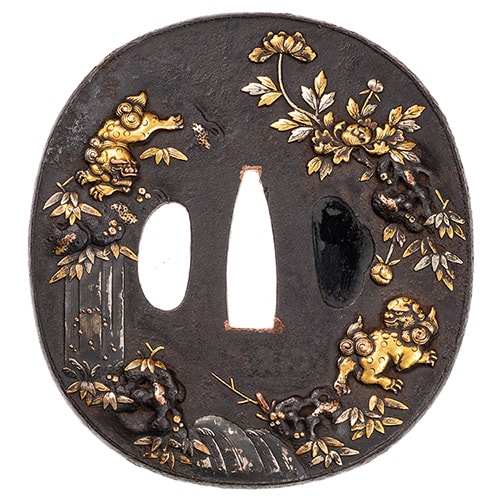
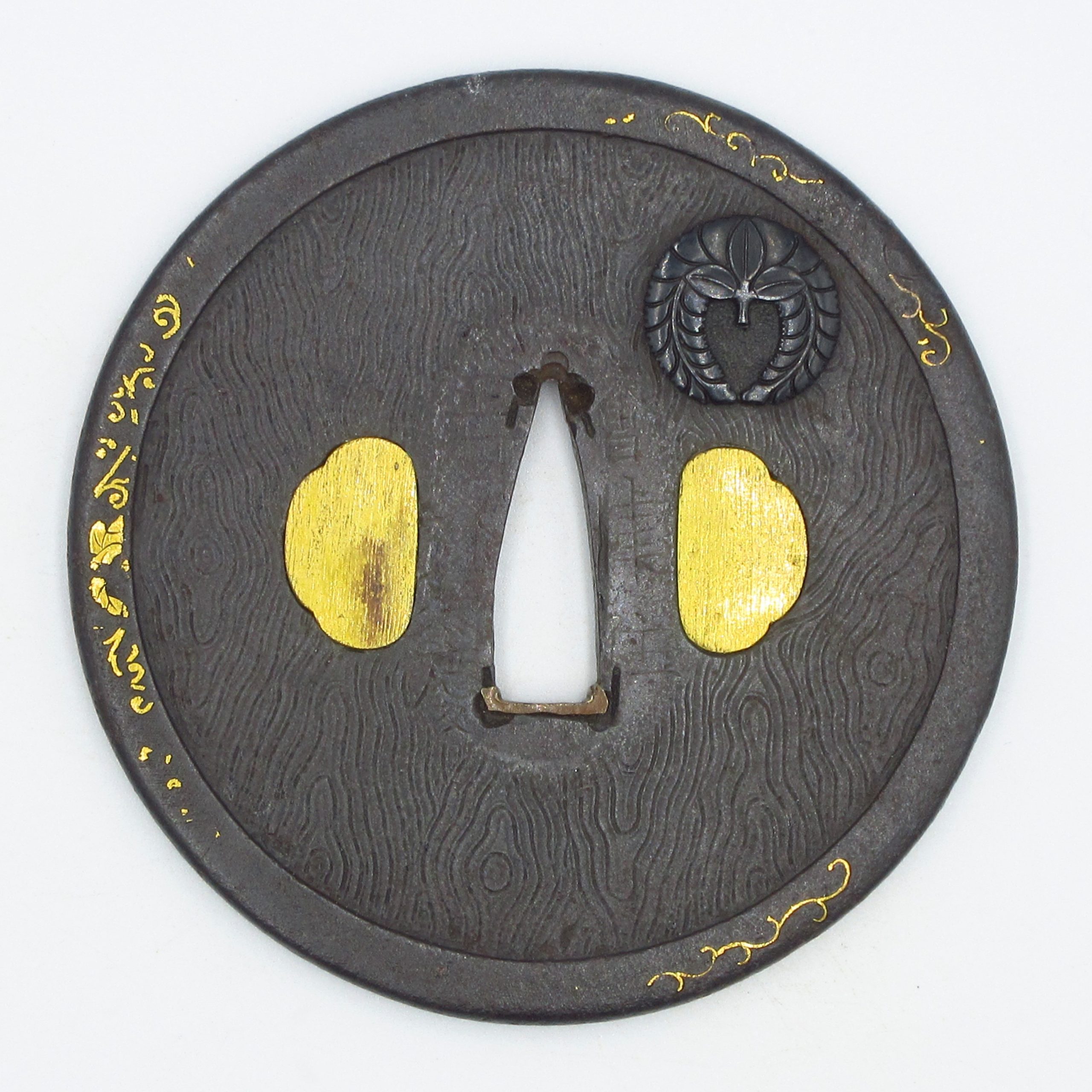
Katsuyoshi's oeuvre is distinguished by a boldly scaled and imposing construction combined with steady and dependable chisel handling. His is weighty and pronounced, and his polychrome -- characteristically sparing, employing only small amounts of gold and against -- nevertheless achieves a strong overall effect. His insect compositions, rendered with close observation faithful to direct study from life, display striking realism, while his figural subjects possess a mirror-like obverse-reverse symmetry and narrative contrast. Painstakingly meticulous inlay is carried out to the fullest extent, whether in five-metal work on iron or monochromatic relief.
The repeatedly identifies in Katsuyoshi's work a quality that transcends refined taste to convey a palpable spirit of dominance and force. His late masterpiece at seventy-three carries the vigor of his chisel into the tips of reed leaves and crane's plumage, achieving not only furyu but compelling power. Both in the thoroughly realized chisel work and the intent of his designs, his pieces are counted among the foremost of their kind. After the Restoration, he applied these techniques to decorative arts -- vases, incense burners, okimono -- producing works the terms powerful late-life tours de force, confirming his standing as one of the most accomplished metalworkers of the late -Meiji transition.