NihontoWatch MonNihontoWatchBETA
MarketEncyclopedia
NihontoWatch Mon

NihontoWatchBETA

Market
Encyclopedia
Overview·Kantei·Designations·Blade Forms·Signatures·School
OverviewKanteiDesignationsBlade FormsSignaturesSchool
  1. Schools
  2. Ishido
  3. Fukuoka Ishido
  4. Moritsugu

Fukuoka Ishido Moritsugu

守次

Jūyō
Vol. 22, No. 338 · Katana

Fukuoka Ishido Moritsugu

守次

10 ranked works

ProvinceChikuzenEraEnpō–Genroku (act. c. 1680–1700)PeriodEdoSchoolIshido>Fukuoka IshidoTraditionShintoFujishiroJo sakuToko Taikan350(top 49%)TypeSwordsmithCodeMOR369
10Jūyō Tōken

Overview

Moritsugu of Fukuoka in was the son of the smith Ishido Rihei, and when his father died he went to study under his cousin Koretsugu; when Koretsugu's heir Toshitsugu predeceased his father, Moritsugu is said to have succeeded to the headship of the main line. He signed himself first Gonsabe and later Hansabe, and died in Genroku 14 (1701), aged sixty-nine. The published sources name him, with Koretsugu, the representative smith of the Fukuoka Ishido, the branch of the wider Ishido enterprise that set out in the new-sword era to recover the clove-flower temper of the old Fukuoka . They rank his school beside the branch of the line as one of the two pillars of the province's new-sword work, and on his fullest blade they write that Moritsugu's strengths are amasu tokoro naku happatsu sareta, displayed without reserve.

His recognized hand is a single manner, held with unusual consistency across the signed by which he is known. The temper is a mixed with , taken broad in , and its governing peculiarity is that the pattern overall leans the wrong way, a slant that runs counter to the upright cloves of the he otherwise looks back to. The published sources trace this reverse cant, and the nuance that goes with it in the , to Koretsugu's training under Sakon Korekazu of the Ishido, writing that ni ga ari, the forging carries a flavor. Within the enter and , the -dominant with along it, and and pass through. The single feature the published sources mark as Moritsugu's own is an edge in which the crest of a clove climbs so far that it reaches the , a broad swelling form they record as popularly called the ika no atama, the squid head; on one early blade the idea is put as cloves like a squid's bag.

The beneath this temper is an that flows strongly and, in its lower half especially, draws over toward , so that the steel reads as a coursing grain rather than a still one. Fine settles across it and, on the closely worked pieces, thread through where the grain opens. Standing in that is the trait by which the whole school is known and by which it justified its archaism: a , a cloudy reflected shadow of the temper, deliberately raised at a date when reflection had otherwise vanished from new-sword steel. It is the visible proof of the revival, the Fukuoka fetched back two and a half centuries; on his broadest blade the reflection even divides by face, a on one side and a straighter, -toned reflection on the other. The answers quietly, turning in a often brushed with , sometimes entering as a small before it rounds, now and again pointing or taking a short jizo-like turn.

The consistency of the hand means his manner is better read in two grades than as a sequence of periods. The ordinary grade is the typical Fukuoka Ishido : a blade, , with a and, against the stiff shallow curve of its -era contemporaries, a comparatively deep , which the published sources offer as itself a mark of the group's shape. The fuller grade widens everything. The opens until the squid-head crests climb to the ; within the gather , , angular and pointed elements; are set here and there and the back is freely tempered in , and the whole turns brilliant. His finest recorded blade, broad in and thick in , belongs to this grade, and it is of it that the published record speaks of his strengths displayed without reserve. A second line runs through the signatures themselves: the long inscriptions are cut in large characters with a thick chisel in a hand the published sources single out as , gyo, reisho majiri, blending the formal, running and clerical scripts, and several blades carry the added declaration that they were forged i nanban-tetsu, with imported steel, two of them dated to Tenna 4 (1684).

What sets Moritsugu apart is best drawn from his own steel rather than by contrast. The Fukuoka of tempered its cloves upright over a quiet ; Moritsugu keeps the clove and the revived but lays them over a coursing, -leaning and cants the whole pattern in reverse, so that an upright old- brilliance is recast in a flowing new-sword grammar. That recasting is the Ishido inheritance carried home to through Koretsugu, and the squid-head crest is the local accent added on top. The published sources value him at the head of the school for exactly this: a maker who could specialize in the clove temper, raise the school's reflection, and still stamp the result with a form of his own. They write of his earliest designated blade that he was skilled in the temper and showed a reflective tendency, and judge it a quintessential and representative example; of his broadest, that in it Moritsugu's true province is displayed without reserve, the squid-head edge, the deep and the wide reflective all in full relief.

Moritsugu's record stands entirely at the level, ten blades across a long span of sessions reaching from the 1960s to 2001, all signed and all , with no National Treasures or Important Cultural Properties among them and no recorded provenance attaching to any. The Nihonto Koza places him a solid step into the upper craftsman ranks rather than at the summit, and that is the honest measure of him: a representative master of a respected provincial school, not one of the great names whose blades pass between famous houses. One of the ten is a rarity, a collaboration signed jointly by Moritsugu and his son Morimasa with the supplementary line kirimono dosaku, the carving by the hand; the published sources note that, since works of the smith Yoshimasa survive bearing carvings by Moritsugu, he was adept at as well. For a collector the school is reachable in a way the it imitates is not. His signed blades come to dealers from time to time, more often than those of the first rank and recognizable at a glance by the broad reverse-canted cloves, the raised and the bold multi-script signature, so that a sound example is a realistic, if patient, acquisition rather than a thing one may only read about.


Kantei

one consistently held Fukuoka Ishido manner, read in two grades: the typical choji-midare on a masame-leaning, utsuri-bearing ji with overall saka-gakari (the all-but-uniform signed katana), set beside a broader, more flamboyant register of wide yakihaba with the squid-head edge, tobiyaki and muneyaki; the work-type axis is the signature itself, the thick-chisel long mei in a multi-script hand, often with a nanban-tetsu declaration

Moritsugu is a Chikuzen Shinto smith of the Fukuoka Ishido school, the son of Ishido Rihei of Fukuoka who, after his father's death, studied under his cousin Koretsugu and in time succeeded to the head of the line; he called himself Gonsabe and later Hansabe, and died in Genroku 14 (1701) at the age of sixty-nine. With Koretsugu he is named by the published sources as the representative smith of the Fukuoka Ishido, which they rank alongside the Chikuzen Nobukuni group as one of the twin pillars of Chikuzen Shinto. His recognized hand is a single manner held very consistently across his signed katana: over an itame that flows strongly and inclines to masame, with ji-nie and a midare-utsuri that stands clearly, he tempers a broad choji-midare mixed with gunome that overall slants in reverse (saka-gakari), the nioiguchi nioi-dominant with ko-nie, the boshi a ko-maru often with hakikake. The masame-leaning ji and the saka-gakari are the inheritance the published sources trace to Koretsugu's study under Sakon Korekazu of the Edo Ishido; the deliberately revived midare-utsuri keeps the flavor of the old Fukuoka Ichimonji the school looked back to. The tell that the sources name his own is a distinctive edge in which the crest of the choji climbs so broadly that it reaches the shinogi, popularly likened to a squid head (ika no atama). His long signatures are cut in large characters with a thick chisel in a distinctive hand blending kaisho, gyosho and reisho, and several of his blades declare nanban-tetsu in an added inscription.

Diagnostic discriminators

unique vs Bizen/Ichimonji choji baseline (no squid-head term)

unique vs Fukuoka Ichimonji choji (no reverse slant)

80% of his works · 16.0× vs Kanbun-Shinto baseline (utsuri lost)

unique vs Fukuoka Ichimonji itame (no masame flavor)

Observation by phase

The typical Fukuoka Ishido choji-midare (his recognized prime)

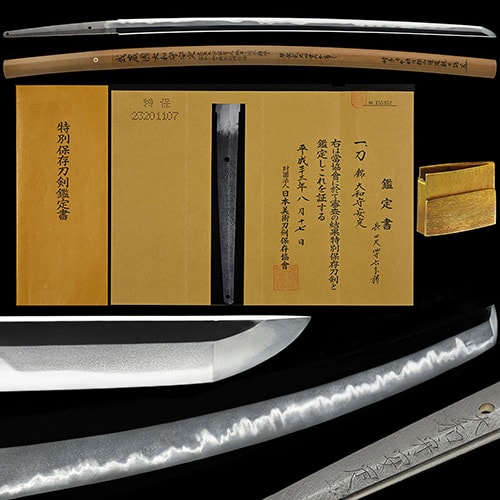
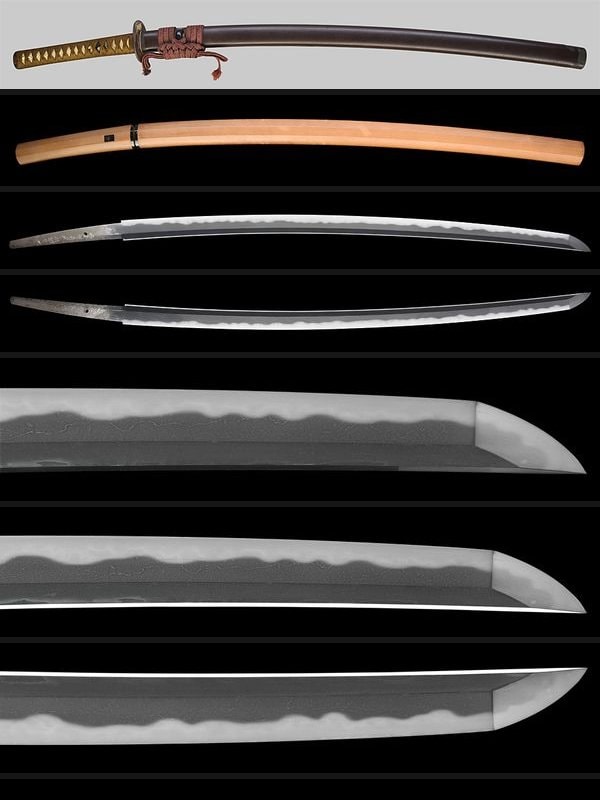
His most consistently described work is a shinogi-zukuri katana, ubu, with a chu-kissaki and a sori that for the Kanbun-Shinto period runs comparatively deep, which the published sources note as itself a trait of the group's sugata. Over an itame that overall flows and in places becomes masame-inclined, the ji carries ji-nie and a midare-utsuri that stands out clearly, the revived reflection of the old Fukuoka Ichimonji the school took as its model. The temper is a choji-midare mixed with gunome and small gunome, broad in yakihaba, in which the pattern overall slants in reverse (saka-gakari); ashi and yo enter, the nioiguchi is nioi-dominant with ko-nie adhering, and sunagashi and kinsuji run through. The boshi turns in a ko-maru, often with hakikake, sometimes entering in midare-komi. The published sources read the masame nuance in the ji and the saka-gakari of the choji as the inheritance from the Edo Ishido through Koretsugu's teacher Sakon Korekazu.

Sugata 姿
Jigane 地鉄
Hamon 刃文
Bōshi 帽子

The broad, flamboyant register with the squid-head edge

less firmly establishedthe broad-yakihaba register is keyed to his finest signed katana, the deeply tempered 47th-session blade chief among them, where the squid-head edge and tobiyaki are most pronounced

A second grade of the same hand runs broader and more flamboyant. The yakihaba widens until the crest of the temper climbs to the shinogi, the distinctive form the published sources record as popularly termed ika no atama (squid head); within a choji-midare of many kinds appear gunome, ko-gunome, angular and pointed elements, with tobiyaki placed here and there and vigorous muneyaki, the nioiguchi clear and bright. The deeply tempered 47th-session katana, broad in mihaba and thick in kasane, is the fullest example, where the sources judge Moritsugu's strengths displayed without reserve. On these pieces the ji is at its most active, with fine ji-nie, chikei, and the midare-utsuri reading on one face while a straight, sugu-like utsuri stands on the other.

Jigane 地鉄
Hamon 刃文
Bōshi 帽子
Scholarship

The published sources place the Fukuoka Ishido, with Koretsugu and Moritsugu at its head, beside the Chikuzen Nobukuni group as one of the twin pillars of Chikuzen Shinto, and trace its style to the Edo Ishido by way of Koretsugu's study under Sakon Korekazu, so that the forging shows a masame flavor and the choji-midare inclines to a reverse slant.

The published sources also note that, while the Ishido group's construction generally reflects the Kanbun-Shinto period flavor, the Fukuoka Ishido blades are often seen with a comparatively deeper sori, which they offer as a trait of the group's sugata; and that several of Moritsugu's blades declare in an added inscription that they were forged with nanban-tetsu, dated examples of Tenna 4 (1684) being valuable for fixing his period of activity.

Designations

Kokuhō—
Jūyō Bunkazai—
Jūyō Bijutsuhin—
Gyobutsu—
Tokubetsu Jūyō—
Jūyō Tōken10

Elite Standing

0.07 across 10 designated works

Top 20% among smiths

Blade Forms

Distribution across 10 ranked works

Signatures

Signature types across 10 ranked works

Currently Available

Fukuoka Ishido School

Other artisans of the Fukuoka Ishido school

  1. 1.Koretsugu是次1 for sale7designated