NihontoWatch MonNihontoWatchBETA
MarketEncyclopedia
NihontoWatch Mon

NihontoWatchBETA

Market
Encyclopedia
Overview·Kantei·Designations·Blade Forms·Signatures·School
OverviewKanteiDesignationsBlade FormsSignaturesSchool
  1. Schools
  2. Chiyozuru
  3. Kuniyasu

Chiyozuru Kuniyasu

國安

Jūyō
Vol. 26, No. 110 · Katana

Chiyozuru Kuniyasu

國安

4 ranked works

ProvinceEchizenEraTeiwa (1345–1350)PeriodNanbokuchōSchoolChiyozuruTraditionYamashiro-denGeneration1stToko Taikan700(top 17%)TypeSwordsmithCodeKUN1672
4Jūyō Tōken

Overview

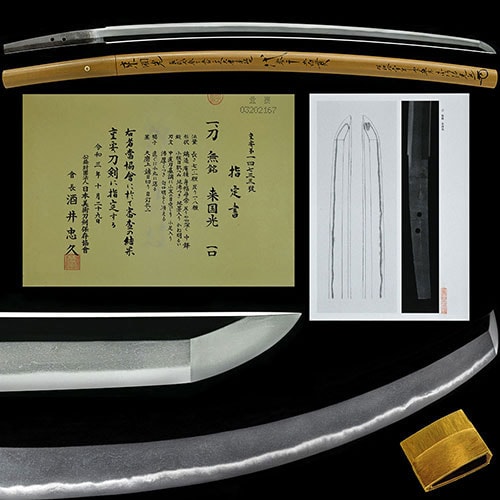
An bearing the vermilion 千代鶴国安 is preserved at Atsuta Jingu, the kind of dedicated great-sword in which the name of this smith survives most directly, for almost everything else on his designated record is a greatly shortened and left unsigned, handed down with the attribution to Kuniyasu. The published sources transmit Kuniyasu as a man born in Yamashiro Province and, by one tradition, a grandson of Kunisue, who later "moved to and became the founder of the Chiyozuru lineage" (のち越前に移住し千代鶴派の祖となった); the reference works place him around the Joji and Sadaji years of the period, noting that "the sword reference works set his era around the Joji era" (銘鑑はその年代を貞治ころとしている). His is a hand read as the tradition carried out of the Yamashiro capital and inflected by the province that received it, and at first glance a blade of his "can appear akin to works of the Yamashiro homeland, particularly those around Kunimitsu" (一見山城本国の来国光あたりにも見える), yielding only slightly on close examination, so that, as the published record puts it, the received tradition "is judged acceptable" (所伝は認められる).

The feature that marks him apart from that homeland is the . Where the Yamashiro smiths forge a tight, refined , Kuniyasu's is mixed with and, in places, , and it stands somewhat open, a tendency the published sources read as his provincial flavor. Over this standing the forms thickly, at times dust-fine, and the enter frequently, while the steel takes a slightly blackish tone and a whitish cast, the that recurs across his blades. The published commentary makes this the decisive point of appraisal: it is precisely because the grain stands and the steel turns whitish and dark that "here the appraisal to Kuniyasu is confirmed" (ここに来国安の極めが首肯される), the work judged not the homeland's but his.

The temper is a into which small mix, the base sometimes carrying an extremely shallow tendency. Along the the edge is restless beyond what the homeland shows: , and at times appear, and enter, thick adheres and in places flares into a coarser, especially brilliant , while fine and run through a bright . The ranges from a quiet with to a far more active turnback, on one blade the growing strong and breaking up along the and running to vigorous on the with a flame-like, impression. Of one the published sources write that these features "clearly express the characteristics of work of the period" (地刃に南北朝期の来派の特色をよく現わしている), the inheritance still legible beneath the provincial cast.

Within this one prime manner the blades fan out along a single axis, from the restrained to the flamboyant. At the quiet end stand pieces whose runs nearly straight, the activity confined to slight and a nuance along the edge. At the active end stands the Joji-era of the 61st session, dated by the reference works to around the Sadaji era, in which "an especially brilliant, coarser " (一際光の強い荒めの沸) sparkles here and there within the bright and the turns to its flame-like form; of this blade the published sources observe that "a rusticity exceeding even the Yamashiro homeland is conspicuous even in the " (帽子にも山城本国以上に野趣ある働きが目立って), naming the very excess of activity as the mark of the provincial workshop. The surviving blades are and almost without exception, so that the recognition rests on this reading of and rather than on a signature, the lone exception being the dedicated .

The published sources set Kuniyasu in relation to his school by resemblance and slight distinction rather than by contrast. Upstream he stands within the Yamashiro line, near enough to Kunimitsu that a first impression can mistake the two; the gap is one of refinement, the homeland's and holding a degree of polish his yield. Downstream he is the founder, the smith from whom the Chiyozuru workshop of descends, and the very features that distinguish his blades from the capital, the standing grain, the blackish whitish-cast steel, the rustic edge and , are the provincial inflection that opens that local tradition. The bright activity and the brilliant coarse of his most active work set him apart on his own grounded terms, a hand turned rustic in the north.

Fujishiro records no rating for him and his designated output is modest: five works carried to , with no National Treasure, no Important Cultural Property and no among them, four of the five the that carry the Kuniyasu attribution and one the signed piece that belongs to a different hand. No early provenance is recorded for his blades. What survives in a public sanctuary is the held at Atsuta Jingu, a great-sword preserved as patrimony rather than as a thing that trades, and it is in that dedicated piece, not in the market, that his name is read most plainly. None of his designated work is locked away as inalienable cultural property, so the handful of sit in the tradeable tiers; even so, a blade securely appraised to the founder of the Chiyozuru line is encountered only rarely, and the collector who meets one meets a inheritance read through the steel of .

Kantei

one prime manner read across the surviving o-suriage mumei katana: a chu-suguha with ko-gunome over a standing itame-mokume-nagare jigane, bright nioiguchi and thick nie, the Rai tradition carried into Echizen and inflected by a provincial, whitish, blackish-toned ground; within it a more flamboyant Nanbokucho register where the nie flares coarse and brilliant and the boshi runs to a flame-like turnback

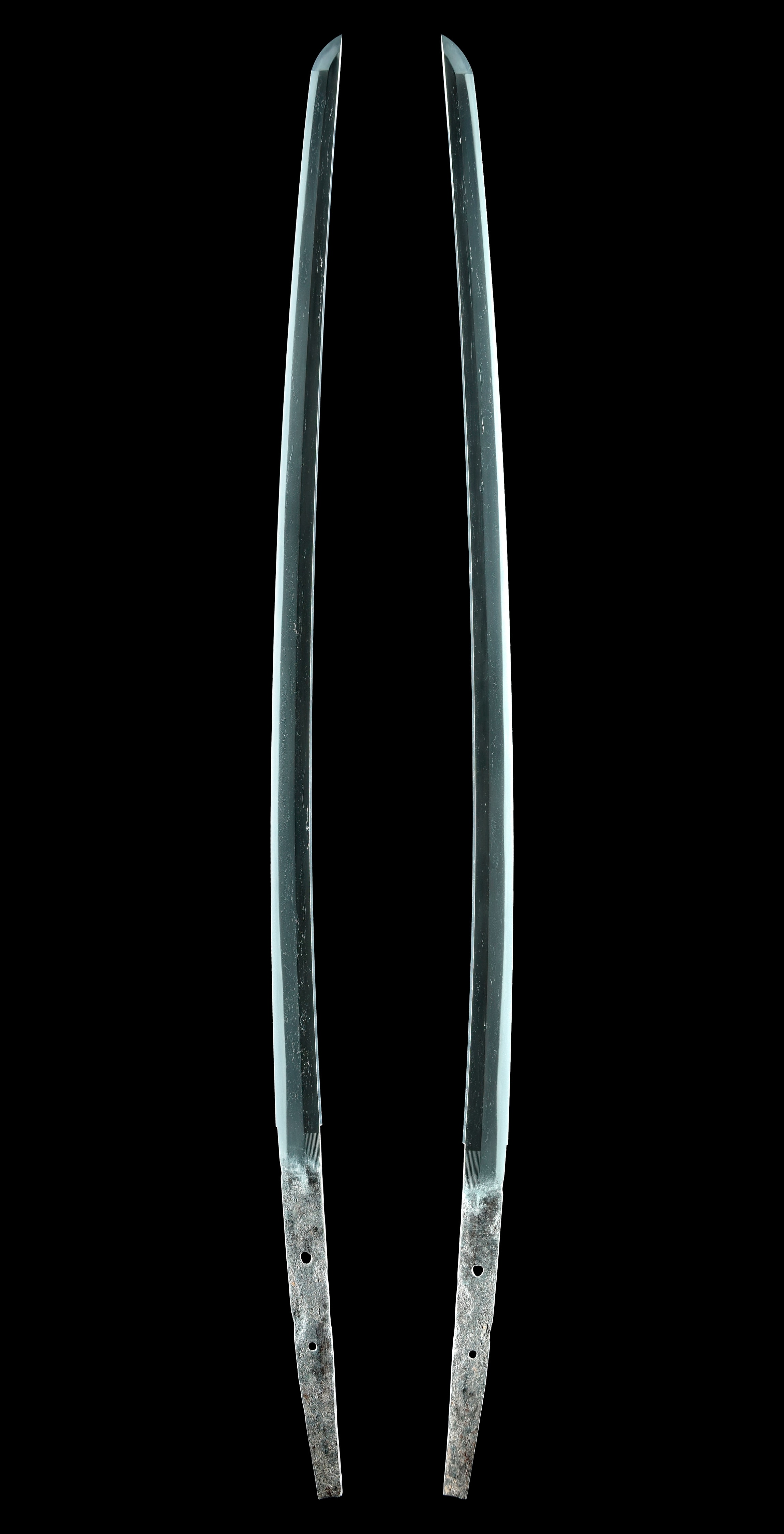
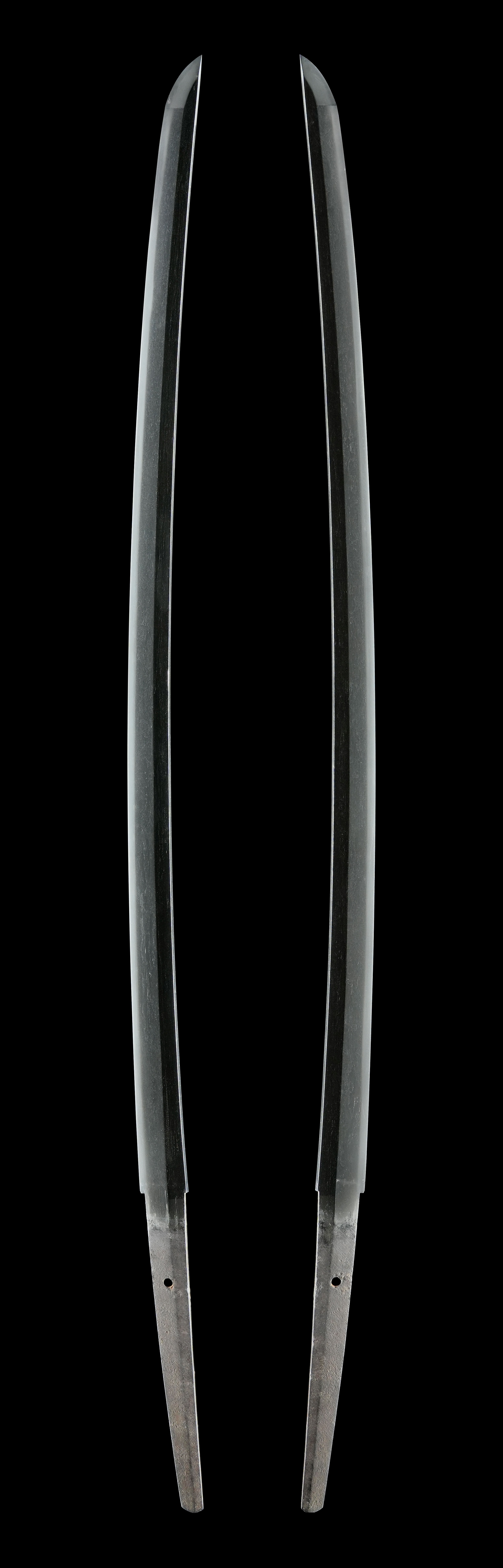
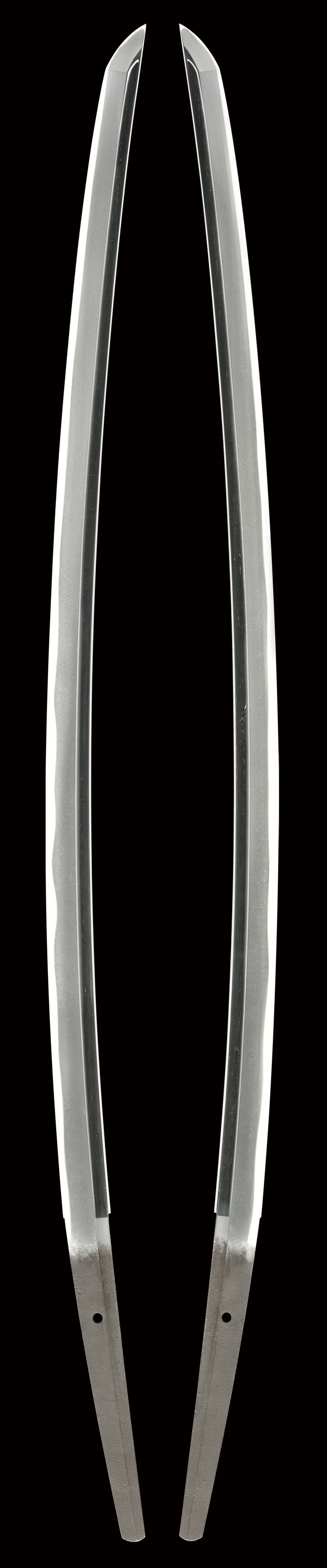
Rai Kuniyasu, born in Yamashiro and held by one tradition to be a grandson of Rai Kunisue, moved to Echizen and became the founder of the Chiyozuru lineage; the sword reference works place him around the Joji and Sadaji years of the Nanbokucho period. On record he survives almost entirely as o-suriage mumei katana carrying the den attribution to Rai Kuniyasu, and his hand is read as Rai work seen through a provincial lens. Over an itame mixed with mokume and nagare-hada that stands somewhat open (hada-dachi), the ji-nie forms thick and the chikei enter frequently, the steel taking a slightly blackish tone and a whitish cast (shirake-gokoro) that the published sources read as the provincial flavor distinguishing him from the Yamashiro homeland. The hamon is a chu-suguha into which ko-gunome mix, with ashi and yo, hotsure, kuichigai-ba and at times nijuba along the habuchi, thick nie that in places flares into coarse, brilliant nie, kinsuji and sunagashi throughout, and a bright nioiguchi; the boshi runs from ko-maru with hakikake to a vigorous, flame-like (kaen) turnback. The published sources judge that at first glance his blades can approach Rai Kunimitsu of the Yamashiro homeland, but yield slightly in the workmanship of both ji and ha, and that the standing grain, the blackish steel and the rustic activity even in the boshi confirm the appraisal to Kuniyasu.

Diagnostic discriminators

75% of his works

50% of his works

the base temper: a chu-suguha into which ko-gunome mix, the habuchi worked with hotsure, kuichigai-ba and nijuba and a bright nioiguchi, the Rai suguha carried into Echizen with more restless edge activity than the homeland

25% of his works

Observation by phase

Prime manner: chu-suguha with ko-gunome over a standing Rai itame, bright nioiguchi, provincial cast

The stance is shinogi-zukuri with iori-mune, the surviving blades o-suriage and mumei; the mihaba is wide with almost no difference between base and tip widths, koshizori is retained even after shortening with curvature added toward the point, and the kissaki runs to chu extended or o-kissaki, a configuration the published sources appraise as Nanbokucho. The kitae is an itame mixed with mokume and, in places, nagare-hada, standing somewhat open (hada-dachi); the ji-nie forms thick and at times dust-fine, the chikei enter frequently, the steel takes a slightly blackish tone and a whitish cast (shirake-gokoro). The hamon is a chu-suguha into which small ko-gunome mix, with a very shallow notare tendency at times; ashi and yo enter, the habuchi shows hotsure, kuichigai-ba and at times nijuba, thick nie adheres and in places a coarser, especially brilliant nie is mixed in, kinsuji and sunagashi run finely, and the nioiguchi is bright. The boshi runs sugu or notare-komi to a ko-maru turnback with hakikake, and at its most active becomes nie-kuzure on the omote with vigorous hakikake on the ura, giving a flame-like (kaen) impression. Horimono, where present, is bo-hi carved through on both sides or run off into the nakago.

Sugata 姿
Jigane 地鉄
Hamon 刃文
Bōshi 帽子
Scholarship

The standing judgment of the published sources is that Kuniyasu was a Yamashiro-born Rai smith, by one tradition a grandson of Rai Kunisue, who moved to Echizen and founded the Chiyozuru lineage, the reference works dating him around the Joji and Sadaji years.

The same sources read his blades as Rai work seen through a provincial lens: at first glance they can resemble Rai Kunimitsu of the homeland, but the workmanship of both ji and ha yields slightly, and the standing grain, blackish whitish-cast steel and rustic boshi confirm the appraisal to Kuniyasu rather than to the Yamashiro homeland.

Designations

Kokuhō—
Jūyō Bunkazai—
Jūyō Bijutsuhin—
Gyobutsu—
Tokubetsu Jūyō—
Jūyō Tōken4

Elite Standing

0.02 across 4 designated works

Top 28% among smiths

Blade Forms

Distribution across 4 ranked works

Signatures

Signature types across 4 ranked works

Currently Available

Chiyozuru School

Other artisans of the Chiyozuru school

  1. 1.Mitsuyuki光行1designated
  2. 2.Morihiro守弘1designated
  3. 3.Morihiro守弘1 for sale4designated